Showing posts with label NFL. Show all posts

Wednesday, February 5, 2014

My Turn Sitting in the Best Seat in the House (Shooting the Seahawks with Rod Mar)

Seahawks Fan - Copyright Ron Martinsen
Seahawks Fan

As a kid I was a football junkie who followed his favorite team carefully and knew what was going on with all of the players. I knew the other divisions and opponents well and I dreamed of the day when my little league football practices would pay off big as I got my shot to be a NFL football player.

Of course, I was young and idealistic so I eventually realized that my 6’1” 120 lbs frame in High School was sure to face certain death if I continued to play ball, so I hung up the cleats and became a TV fan like the rest of the world. However, the passion and desire to be on the field for an NFL game was intense, but I accepted the reality that day would probably never arrive. Instead, I chose other sports to shoot and enjoyed my successes as a motorsports photographer.

Shortly after I got my Canon 1D Mark III the passion to be closer to football burned again when my good friend Fred Nava sent me a link to a blog on the Seattle Times called The Best Seat in the House by sports photography legend Rod Mar. Rod has 25-years experience shooting sports so his great images captivated me. I watched his blog with great enthusiasm and day dreamed at what it would be like to sit in the best seat in the house with my camera one day. 

Fast forward to 2011 when a charity event at work happens where I get to meet Rod. We exchange some emails online and eventually I got the courage to ask Rod if he’d be up for doing a guest blog article reminiscent of one of his old Best Seat in the House articles. Rod’s a super nice guy so he agrees, but the reality of his busy work schedule kept causing delays.

While heading to my day job one day I get a phone call from Rod . He is now the team photographer for the Seahawks asks me if I could help him out as an assistant for a game. I immediately said hell yes. Since Rod doesn’t make offers like this very often (so please don’t ask), it was like getting called up to the big leagues.

The Big Day – A Dream Come True


A Dream Come True

It was the ultimate Christmas gift to be able to join Rod Mar on December 24th, 2011 against the San Francisco 49ers, so I was on time and ready to go.

After meeting up with Rod at the stadium I was given a vest to use for the game that labeled me as an NFL Photographer for the day. I immediately whipped out my iPhone 4s and snapped the shot above to send to my wife as I tried to contain myself from doing the equivalent of a touchdown celebration. At that moment the perma-grin was so big on my face that my cheeks started to obscure my vision! Here’s a shot taken by Rod as we walked out on the field prior to the game for the first time:

Ron & Blitz - Copyright Rod Mar
All grins looking like Tim Taylor of Home Improvement with my Think Tank Photo Modular Components and Keep It Up Shoulder Strap as well as a Black Rapid Strap 

Happy? Oh hell yeah – you bet! In fact, it only got better from here! I took my turn taking a shot of Rod and Blitz as well:


Team Mascot – Blitz & Rod Mar

Pre-Game Warm Up


Getting Prepped

The stage was set so I got my chance to warm up shooting the pre-game practice. Naturally my camera of choice was the Canon 1D Mark IV with the 70-200mm f/2.8L IS II USM, but a few shots were taken with the 24-105mm f/4L IS. I had a lot more gear of course, but in my frantic pace of keeping up with Rod as his assistant I didn’t feel like futzing with it. As a result, I could have (and should have) left nearly all of it home.
Off to a Running Start
(Canon 1D Mark IV, 70-20mm f/2.8L IS II lens @ 200mm, ISO 400,
1/640 sec., f/2.8)

I was also glad that I didn’t rent a 400mm because I had such great access that I was able to get most of what I needed or wanted with the 70-200mm with insignificant cropping when the action was farther away down the field. I could easily print a 16x24 or larger with the images I took, so the great image quality of my camera was a blessing.


Hangin with the Big Boys
(Canon 1D Mark IV, 24-105mm f/4L IS lens @ 60mm, ISO 640, 1/500 sec., f/4.0)


Lucky grab
Wrong settings but the stars aligned and I got the shot
(Canon 1D Mark IV, 70-20mm f/2.8L IS II lens @ 200mm, ISO 160, 1/250 sec., f/4.0)


Newbie Mistake
Doug Baldwin hands a kid in the stands a ball and I totally missed it – DOH!
(Canon 1D Mark IV, 70-20mm f/2.8L IS II lens @ 70mm, ISO 320, 1/500 sec., f/2.8)


Seagals 2012
Yeah, I could get used to this!

It was cool enough that I was this close to the players, but when the Seagals took the field I was like “oh yeah, awesome”!  Rod is also the official team photographer for the Seagals too (lucky bugger), so he was getting some great shots of them that day as well (starting with #10).

Ready – Action!


Rod breaks out the big boy toys

It was game time and it was time to get down to business. Now technically I was supposed to be Rod’s assistant where I help him schlep his gear around so he can get some great shots of the Seahawks (typically from the end zone with the Seahawks facing us), but I was beside myself with excitement so Rod was gracious enough to let me fire off some rounds. Here’s a shot he took of me during the actual game:


The Worst Assistant – Ever!
(FYI that film camera is for this)

Instead of doing my job, I was too busy grabbing shots like this from across the field:


Too Slow Joe
Cool shot, but lame compared to Rod’s (Search for Sherman here)
(Canon 1D Mark IV, 70-20mm f/2.8L IS II lens @ 200mm, ISO 1000, 1/250 sec., f/2.8)

Rod was nailing shots left and right using a 400mm lens with a 1.4x teleconverter (which if you’ve tried to follow action with that level of zoom, you know that’s tough!). However, I was struggling to get a good composition. I managed to get a few here and there like this:


(Canon 1D Mark IV, 70-20mm f/2.8L IS II lens @ 145mm, ISO 400, 1/1000 sec., f/2.8)

but it was tough. I’ve got the geek skills to know how to get the most out of the Canon 1D Mark IV so I was getting crystal clear sharp shots all day long (nearly 2800 by the end of the day), but getting the shot at the right moment framed properly is where you separate the posers like me from the legends like Rod.


(Canon 1D Mark IV, 70-20mm f/2.8L IS II lens @ 200mm, ISO 400, 1/1000 sec., f/2.8)

Sure I managed to get some good shots like the ones above and below, but when you take as many shots as I did with the right gear (and you know how to use it) then you are going to get lucky eventually.


(Canon 1D Mark IV, 70-20mm f/2.8L IS II lens @ 200mm, ISO 500, 1/1000 sec., f/2.8)

But often times I had accidentally let my shutter speed drop too low so the perfectly timed shot would be a tad blurry:


(Canon 1D Mark IV, 70-20mm f/2.8L IS II lens @ 200mm, ISO 1000, 1/800 sec., f/2.8)

I was also stupid and didn’t bring enough memory cards, so I ended up shooting half the game in JPEG instead of RAW and that hurt the image quality quite a bit. In my rush I just set the camera back to some old settings I had registered and they were too aggressive with the in-camera noise reduction (see above) – vs – RAW shots like the one below:


(Canon 1D Mark IV, 70-20mm f/2.8L IS II lens @ 70mm, ISO 320, 1/1000 sec., f/2.8)

Lessons Learned


Woohoo!

I had the time of my life, but I feel guilty for letting Rod down by not being a better assistant. Hopefully I’ll get a chance to do this again one day, but even if I didn’t I’m eternally grateful to Rod Mar for this incredible opportunity.

With respect to gear, I was very happy that I packed my Black Rapid RS-Sport (Adorama & B&H) as it worked brilliantly during the game when I was running around with my camera on my side. I was also thankful to Glazers Camera in Seattle giving me a Stuff It Microfiber Lens Cloth which I loved. I also made the right choice to use the Think Tank Photo Modular Components and Keep It Up Shoulder Strap (brilliant for phone and memory cards) as that kept all of my gear ready for me to get to quickly and easily (even if I was afraid to grab some of it due to fear of missing something).

My only regret was not getting some good knee pads as you spend a lot of the game on your knees and my bad knees weren’t built for that. They literally still bother me since that day, so that a was a big mistake on my part.

My Canon 1D Mark IV New Users / Shoppers Guide was balls on with its advice. If you REALLY understand the AF system of the 1D Mark IV (and few do), you can get a large number of sharp and in-focus shots.


Seagals transitions between movement and still
was actually harder to get perfect than game play!

The camera’s biggest flaw is that there’s no fast way to toggle the One Shot AF mode (needed for still shots) to AI Servo (needed for tracking moving subjects) unless you have a big lens with a AF Stop button that can be re-programmed. Given this fact most photographers find that using the AF On button to manually control focus and the shutter button for metering and shooting only works better. However, that takes practice so I’m super excited that the upcoming 1D X will allow one its front buttons to be programmed to be a focus mode toggle so I can get more sharp shots during transition periods.

Thanks Rod Mar


(Canon 1D Mark IV, 70-20mm f/2.8L IS II lens @ 105mm, ISO 640, 1/1000 sec., f/2.8)

I’d like to thank Rod Mar for giving me the opportunity to scratch this dream off the bucket list. My day shooting a NFL game between the San Francisco 49ers at the Seattle Seahawks is a memory I’ll never stop talking about.


(Canon 1D Mark IV, 70-20mm f/2.8L IS II lens @ 70mm, ISO 400, 1/1000 sec., f/2.8)

Here’s Rod’s game shots used by the team on their blog. Keep in mind that Rod literally got all of these shots processed during halftime and shortly after the game. It took me nearly a month to go through my shots and lightly process them!

Here’s a photo gallery of game action and the Seagals taken by other pros during the game.

Disclosure

If you make a purchase using select links in this article, I may make a commission. Thank you for supporting this blog by using my links.

Friday, December 13, 2013

REVIEW: Peter Read Miller on Sports Photography

Peter Read Miller on Sports Photography: A Sports Illustrated photographer's tips, tricks, and tales on shooting football, the Olympics, and portraits of athletes is book that I think most male photographers want to read because many of us dream of being on the sidelines shooting our favorite sports.  I loved shooting the Seahawks, Formula 1 Racing, and Motorsports, but I also learned that while it’s sexy it doesn’t pay well as people think when you go down that path. As a result, I moved on to other commercial work that paid better but I still lust for that sidelines fix and excitement I enjoyed at the Winter Olympics.

Peter Read Miller is a legend in sports photography who once was on my Favorite Photographers list. He’s no longer there simply because there’s so much talent out these days that it’s hard to limit that list to just 20 people – but I tried. He’s become popular in Scott Kelby’s world and has some videos on Kelby Training these days, so I suspect that his book was going to be awesome. I mean, this is a Sports Illustrated photographer who I admire because he’s lived my sports photography dream, so this book has to be awesome right?

If you’ve read this book already you probably know where this is going, but if you haven’t then I’m sad to say that I was very disappointed by this book. While it makes a nice coffee table book for its wealth of exciting sports images, am I the only one who thinks the images look like the best of his film days work? Yes, I know he has plenty of digital images taken with the 1D X and its predecessors, but most of those just feel like unprocessed RAW’s. By today’s rigorous standards in the age of digital photography images that are tack sharp with rich colors are the norm, so excellent photography is appreciated on top of that baseline. While the images had outstanding composition time and time again, I felt like I was reading the New York Times with images that went straight from the camera to print. That’s not what I’m looking for when I read a sports book in 2013 in a world where the set of ESPN sets the bar for what we expect from sports visualizations.

To be clear, I know Peter has amazing digital images – I’ve seen them, so that is what makes me more perplexed. Why aren’t they in the book? Perhaps it’s something contractual with Sports Illustrated or something, but as a reader I don’t care about the excuses – I want a book with great sports imagery that grabs me both visually as well as compositionally.

With that disclaimer, let’s put that aside. Let’s assume that these are the best images that are processed (or not) to perfection. Let’s assume I’m in awe at every page with my jaw dropping to the floor. Next comes the question, why do I buy a book like this? The web is filled with amazing images that I can view for free, so I buy a book like this to see fantastic images and learn how I can make great images like that myself. In short, I not only want to be visually satisfied, I want to be educated.

Where this book really falls flat is that it’s lacking of very much educational value. It’s mostly images with camera settings and gear lists, all of which I’d expect. However, when I look at the table of contents I think that I’m going to get some good tips from a seasoned expert and I’m hoping there will be discussions about how I can work my way up to the sidelines for some of these great events that Peter has covered. However, I quickly learned that wasn’t what this book was about. Instead, this is Peter Miller Read’s photo portfolio with some simple banter that you’d get if you were sitting next to him watching him flipping through his printed portfolio. There’s not much depth and halfway through it starts to feel more like bragging than anything else.

Fundamentally I think the problem with this book isn’t that Peter is a bad author, I think it boils down to trying to take too much on in one book. I think if this book was same thickness that focused on one or two sports with 30% of the photos replaced with text content, it would be incredibly helpful for aspiring sports photographers. Peter IS a great photographer with thousands of outstanding sports images with brilliant composition, but somewhere along the way someone let him just fill the book with photos instead of content that takes it beyond a photo portfolio.

I always dreamed of meeting Peter Read Miller one day and having the opportunity to talk to him about sports photography, but this review will probably put that dream to rest. However, I have the opportunity to do that vicariously through his Kelby Training videos (see my KelbyTraining.com discount) and other interview videos of his on the web. I still am in awe of his complete body of work (beyond what this book features) and I’m sure he’s an excellent guy. As a book author it pains me to not be able to write a glowing review about this book, but I’ve got to say that when I finished reading this book I felt that I had wasted my time reading the words. If you get this book, just skip the words and enjoy the photos – they are amazing compositions from every sport known to man.

Conclusion

Peter Read Miller is an amazing sports photography legend and he deserves the utmost respect, but I wish he would have had a better team guide him in a different direction for this book. It should have been named “Peter Read’s Portfolio” and if it was I’d highly recommend it, but instead the title suggests that it will be education and it simply isn’t. Sadly this is the second sports book I’ve read recently that left me disappointed. The first was Sports Photography: From Snapshots to Great Shots which was equally bad, but in a different way.

My recommendation is that if you are looking for a photo book of sports images that you can flip through, then there’s lots of cool compositions to enjoy in this book. If you are looking for education, go take his workshop as that’s probably going to get you what you are really looking for when you buy something like this book.

Where to order

Click here to order at Amazon.

Other articles you may enjoy

If you enjoyed this article, you may also enjoy these:

Disclosure

If you make a purchase using links found in this article, I may make a commission. It doesn’t cost you a penny more, but it does help to support future articles like this. I was given a copy of this book to review.

Monday, December 12, 2011

REVIEW: Think Tank Photo Modular Component Set v2.0 and Keep It Up Shoulder Strap
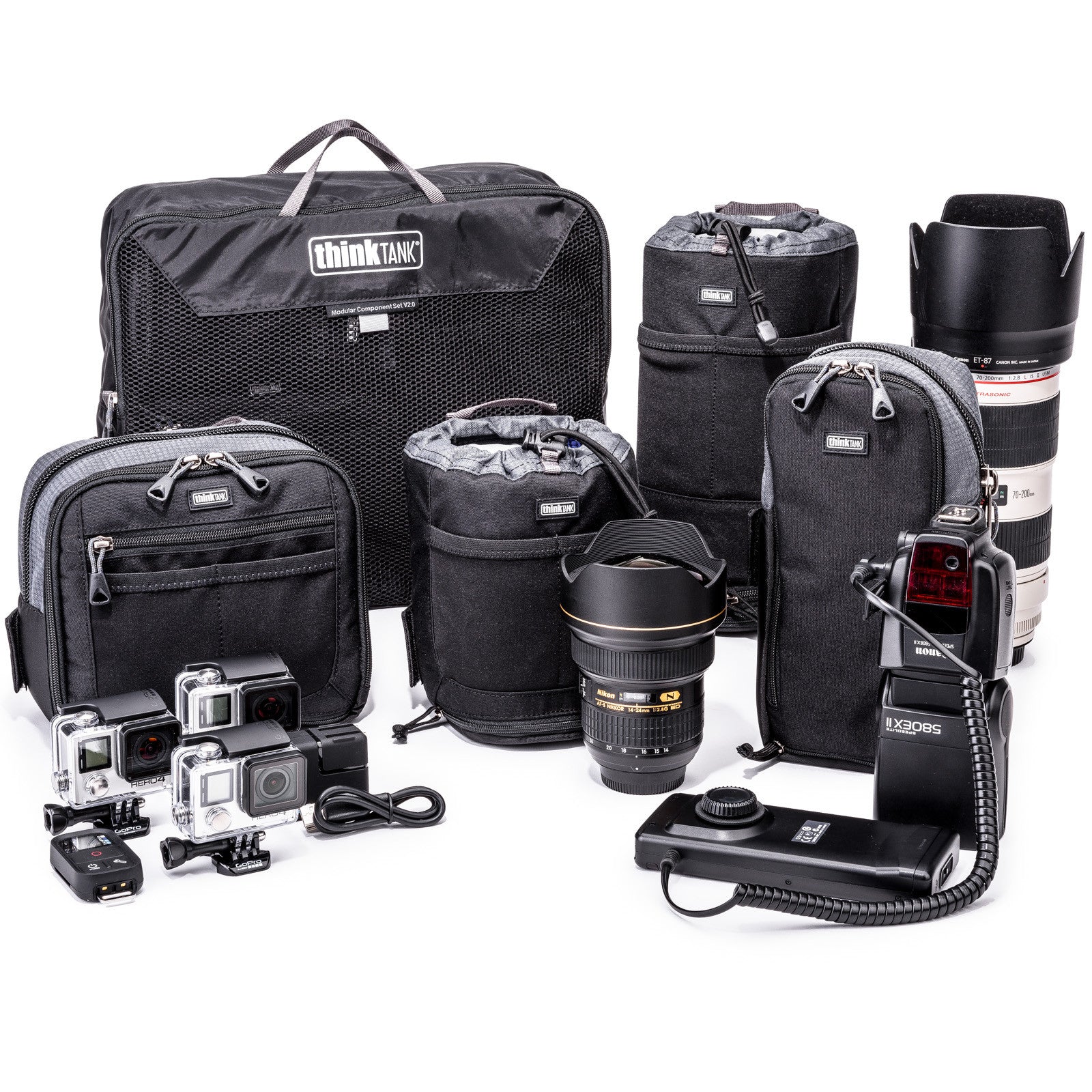
Think Tank Photo Modular Component Set v2.0 Think Tank Photo Modular Component Set v2.0

In the new v2.0 set, Think Tank Photo has reduced the number of included bags down from 6 to 4. Fortunately, the four included are the ones I use 99% of the time so for most this will be a good thing.

The Pro Speed Belt v2.0 belt sold separately so you can pick the size that is right for your waist size.

Here’s what’s included:

  • 4 piece set mesh carrying case
  • Lens Changer 50 V2.0 - Sized for both wide angle and standard professional zoom lenses
  • Lens Changer 75 Pop Down V2.0 - Carries a 70 - 200 f/2.8 or 100 - 400 f/4 with the lens hood reversed or in position
  • Strobe Stuff - Large enough to accommodate a 580EXII or SB900 with an external battery pack and diffuser attached
  • Speed Changer V2.0 - Multiple use pouch that can fit a pro-sized camera body (lens not attached) with room for accessories. Can also be configured with the included dividers to carry small telephoto lenses, teleconverters, RF Transceivers, or pro-size batteries.

Additional lens pouches, and skins are available to complete to your collection.

Keep It Up Shoulder Strap

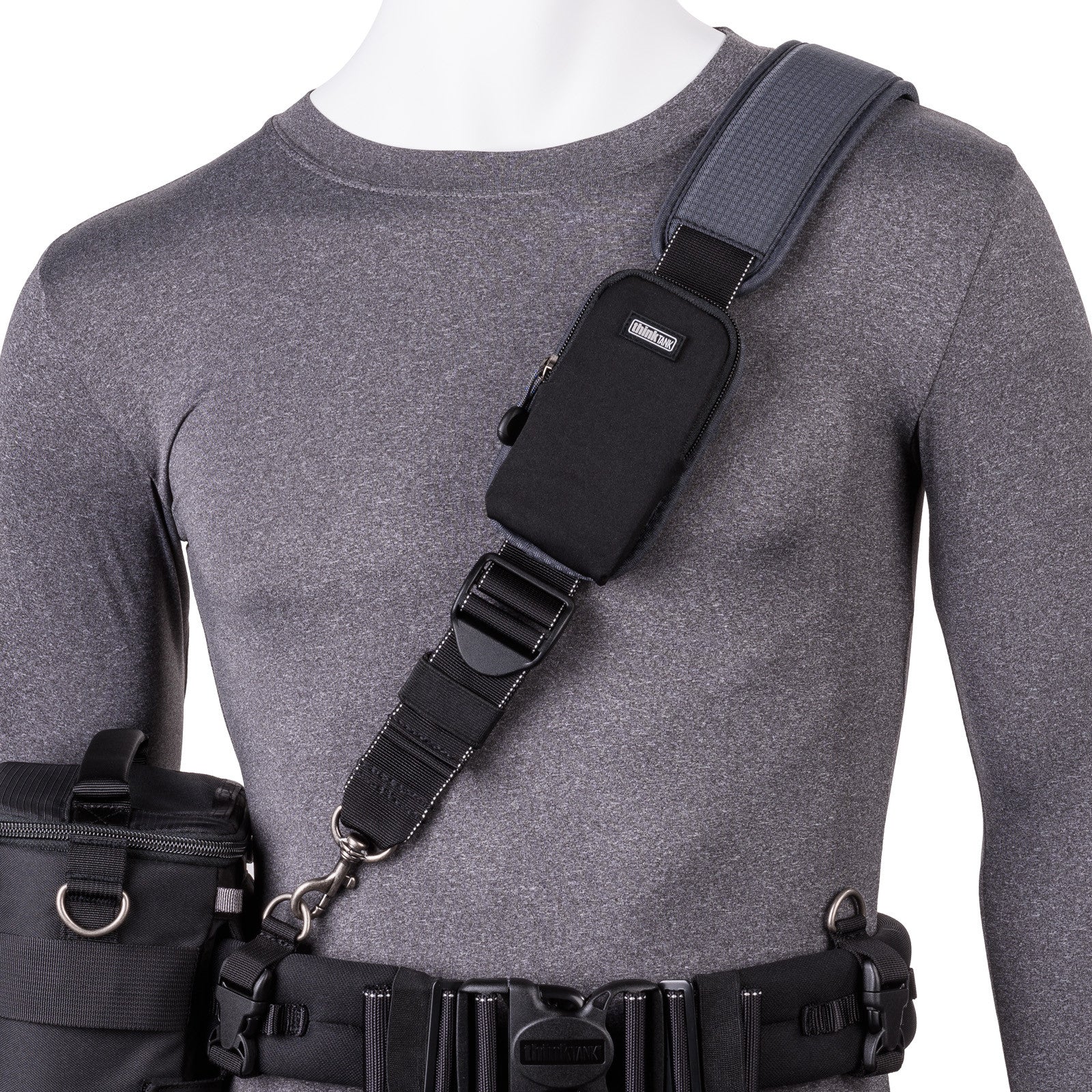
Keep It Up Shoulder Strap Keep It Up Shoulder Strap

One of the challenges with the modular belt is that the weight of your gear and the lack of wide hips can result in a little downwards creep of your belt. I’ve never had a belt fall off, but I’ve needed to stop and re-tighten my belt on occasion to make sure I was comfortable with it staying put. Think Tank Photo has addressed this issue with the new Keep It Up Shoulder Strap which gives you additional support for your belt as well as a place to store your phone.

This strap is a wider version of what you’d find on the wonderful Artificial Intelligence laptop bag. Unfortunately it lacks any substantial padding, so I’m not crazy about that part. However, it doesn’t get much weight pressure when used with the belt so some might find the thin strap useful for storage when not in use. The inclusion of a cell phone pocket that can hold an iPhone is so cool that I’ll probably use it as a replacement strap for my Artificial Intelligence 17 V2.0. 

Should v1.0 Users Upgrade?

Watch this video to learn more

While I really like the improvements of the new bags, I’d say that v1.0 users are safe keeping their current bags. As you add bags I’d go for the new v2.0 bags, but I don’t think the convenience of the rain bag storage and new elastic pockets warrant replacing your existing bags.

Conclusion

I love my v1 modular components that I reviewed a year ago. Over this past year I have used them anytime that I only need one body AND when I know my camera will be in my hands more than in the bag. It has been great for event, sports and photojournalism shoots.

I use my Streetwalker Pro or Urban Disguise 40 v2.0 most often when I need larger capacity, and when I’m loaded down I use my Airport Security v2,0. Despite owning all of these bags and more, the modular set has remained an important part of my collection. Because I own both, I’ll be ditching my v1.0 duplicates, but for everyone else I’d say that either v1.0 or v2.0 will serve you equally well.

SPECIAL OFFER - Ordering Information

To order the bags featured in this article, please use these links (includes the FREE BAG offer):

Click here for the latest FREE BAG special offer and other Think Tank Photo bag reviews.

Disclosure

I was provided with a v2.0 modular set, pro speed belt v2.0 and keep it up shoulder strap for this review. I may also get a commission if you make a purchase using the links in this article.