
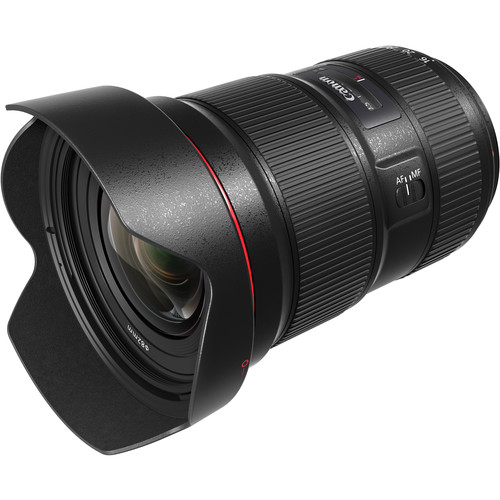
The All New Canon 16-35mm f/2.8L III
I loved my old 16-35mm f/2.8L II USM lens, but it was getting pretty soft compared to most new lenses on the market. While I came close to replacing it for the excellent 16-35mm f/4L IS USM, ultimately it was the incredible Canon 11-24mm f/4L that ended up in my backpack. I've loved my 11-24mm, but all wide angle lenses are low frequency use for me so it's weight meant that it rarely traveled with me.
Given the cost of the 11-24mm, I began to question my investment as I just wasn't using it enough. As a result, I was pretty pumped up when I heard about the new 16-35mm III because I expected it to be everything I loved about my old lens. I was right and it features the incredible sharpness that come with all the new lenses Canon is releasing these days. However, would it be enough to get me to buy it? Read on to find out.
A Different Review
If you are one of my loyal blog readers, thank you. You've probably noticed that my blogging volume has trickled almost to a stop. I'd like to first explain that my work responsibilities have been so intense this year that I've been too wiped out to do my typical 10:00 PM - 4:00 AM blogging schedule, but my blog isn't dead. This will eventually pass and I'll get back to regular blogging again.
With that said, I've been deviating from my regular review patterns this year to shorten the time required to publish, but feedback is always appreciated via my contact me link. This review, like others this year will forgo videos and bookshelf shots and just jump into unedited real world shots with my commentary. There's plenty of sources on the web for the type of stuff I'm dropping so what you get here are my thoughts based on real world usage and years of experience reviewing a lot of lenses.
Rain, Rain, Go Away
f/5.6 @ 16mm for 0.8 sec at ISO 400
Shooting straight up for a long exposure in wet conditions led to drops hitting the lens,
but water in the barrel was never an issue

I had this lens on loan to review from March 11 to April 14, yet I failed to have a single day where the weather and my schedule aligned. As a result, this lens got a great test of its weather sealing while mounted to my Canon 1D X Mark II and it preformed beautifully. While technically you are supposed to use a filter on the end due to the fact that the front of the lens is venerable due to a slight mechanical shift within the barrel. Using a hood kept the rain from hitting the lens element most of the time, excluding extreme examples like above. However, I never had any problems with water leaking into the barrel of the lens.
f/10 @ 22mm for 0.3 sec at ISO 160
From beginning to end, I was always fighting the rain during this review

f/5.6 @ 28mm for 1/320 sec at ISO 640
My one moment of dry weather was complete with clouds and wind and eventually rain, so I had to crank up shutter speeds to stop motion which kept me at high ISO's during this entire review

f/5.6 @ 35mm for 1/60 sec at ISO 800
Cherry Blossoms in Kyoto - Check, Good Weather? Not!

Due to bad weather, I extended my review period and took this lens with me to Japan to shoot the Cherry Blossoms. While I nailed the bloom season perfectly, I fought never ending rain, fog, clouds and wind. While my conditions weren't ideal, I got a great feel of what its like living with this lens and it never disappointed me.
f/7.1 @ 25mm for 1/1000 sec at ISO 3200
Tokyo's Meguro River was beginning to fill with falling blossoms which created a ton of dust, despite rain earlier that day

Something else that wasn't an issue was dust, despite this lens traveling outdoors during pollen season in Seattle as well as all over Japan. Yes, the rain kept the dust to a minimum, but my allergies can attest that there was still plenty of dust in the air. This was confirmed by the outside condition of my gear as well. In short, this lens really surprised me here when it was subjected to photojournalistic field usage conditions.
Real World Shots
All of the photos featured in this article are 100% unedited and link to the in-camera JPEG that my Canon 1D X Mark II generated. Generally speaking, anything below 1/30 sec was probably on my Leica tripod (featured here) and anything greater was freehand (no support of any type).
Most camera settings were default except the camera style and white balance were adjusted to suite my desired look for a shot. Most shots were also shot using manual mode with Auto ISO, so seemingly odd choices for shutter speed were often due to wind conditions or my forgetting to reset manual settings between shots.
Click on the photos in this article to see the original file. You may view them while your browser is open on this article, but all images are copyright Ron Martinsen - ALL RIGHTS RESERVED. You may not print, edit, save, copy, publish, link or otherwise use these images for any reason beyond viewing for this article without an ink signed paper contract.
f/2.8 @ 28mm for 1/250 sec at ISO 1600
This is an extremely sharp lens so detail on leaves was always impressive even at high ISO where sharpness is even more critical as noise reduction will drastically soften the shot. Despite this, this crazy sharp lens always leaves you with a great starting point before post-process sharpening (again, 100% unedited so none applied on any photos in this article)

f/7.1 @ 16mm for 1/50 sec at ISO 2500
Tons of detail in this shot is preserved despite the high ISO

f/3.5 @ 31mm for 1/125 sec at ISO 800
Focus performance was excellent with this lens even for incredibly difficult shots
like this as well as moving subjects

f/5 @ 16mm for 1/250 sec at ISO 320
I love 16mm for the context it offers so I loved the fact that even off center subjects
were still incredibly sharp as shown here

f/5 @ 35mm for 1/250 sec at ISO 400
Zooming in to 35mm also helps curb distortion and hide ugly backgrounds which is why I love the 16-35mm range so much - you can do a lot of shots without needing to switch lenses

f/5.6 @ 35mm for 1/320 sec at ISO 400
Fighting wind, I still managed to get down to ISO 400 which starts to show how incredibly sharp this lens is with excellent detail in the texture on the flower pedals

f/5.6 @ 34mm for 1/320 sec at ISO 125
The extra blades in this lens over its predecessor offer very satisfying bokeh even at f/5.6

f/5.6 @ 35mm for 1/500 sec at ISO 1250
Photographing people with context is my favorite use of this lens,
so I was pleased to see that edge sharpness was excellent.
The fast autofocus means it can easily handle fast moving kids too!

f/5.6 @ 35mm for 1/500 sec at ISO 1250
35mm and under are great for those times when you have to shoot blind with the camera way down low and hope you get something. This was one of those cases!
It should be noted this was on a hill so the camera is level but the terrain is not.

f/4 @ 16mm for 1/80 sec at ISO 10,000
Going wide for context in the crazy dark Matsumoto Castle on an overcast day meant super high ISO, but again the sharpness of this lens helped to offset massive in-camera noise reduction

f/5.6 @ 19mm for 1/10 sec at ISO 800
This is better appreciated at full screen to enjoy the textures that pop despite settings that weren't ideal due to horrible weather past sunset in Kyoto, Japan

f/5.6 @ 35mm for 1/8 sec at ISO 800
To keep ISO's under control I had to live at f/5.6 and use a tripod at very slow speeds.
This kept me from using my preferred settings, but you can still appreciate incredible detail on the moss covered rock wall in this shot.

f/16 @ 27mm for 2 sec at ISO 100
Fog and being out past sunset didn't stop me from giving f/16 a go to see how much detail this lens could get out of this sea of rocks - it did very well

f/5.6 @ 16mm for 0.6 sec at ISO 400
City lights make night time Cherry Blossom shooting in Kyoto, Japan fun, but it does mean you need long shutter speeds which kills the detail of the flowers due to wind moving them.
Lights also can mean flare, but this lens never once gave me any issues with flare.

f/5.6 @ 16mm for 1/60 sec at ISO 200
This was about as low as I could get my ISO and not have a long shutter release.
This was a fun shot that reminded me what I love about 16mm as it helps to do this scene more justice than any larger focal length

f/9 @ 27mm for 1/500 sec at ISO 4000
Against all odds, I'm still impressed with the sharpness of the cherry blossom I focused on

f/9 @ 16mm for 1/30 sec at ISO 3200
Great contrast and color was what made me love version II and version III didn't disappoint.
Now you get that with a crazy sharp lens that holds its own against diffraction and noise reduction software due to crazy sharpness.

Click here for a full gallery of these and more photos.
Conclusion
When you use a lens in the worst conditions you get to see it's worst results which in some ways is pretty helpful. Any lens can take a great shot in perfect weather on a bright sunny day, but it takes a good lens and camera to handle the conditions I faced on two continents during this review.
This lens is every bit as sharp as my 11-24mm and the 16-35mm f/4L IS USM that I tested. What's more, never once was flare a problem even when shooting into bright lights in the evening in Japan. The fast autofocusing also meant that soft shots were only a factor of using low shutter speeds - not the lens AF performance or sharpness. I wish it had the IS of the f/4 as I really could have used that on my trip, but in exchange for that I got beautiful bokeh at f/2.8 so I can live without it.
I love this lens and want to get it. Since I own the 11-24mm I'll probably hold off until I can sell some old gear before I buy it, but I do hope to buy this lens soon.
Simply put, it's fantastic and I highly recommend it.
Where to Buy?
CLICK HERE to learn more or buy today.
Other articles you may enjoy
If you enjoyed this article, you may also enjoy these:
- Canon 8-15mm f/4L Fisheye Zoom
- Canon 11-24mm f/4L
- Canon 16-35mm f/4L vs 16-35mm f/2.8L II
- Canon 24-105mm f/4L IS USM (NEW & tested with the 16-35 III)
- Canon 1D X Mark II
- Canon 5D Mark IV
- Canon 5D Mark IV vs 1D X II - an unscientific comparison
- Canon 5Ds
- Canon 5DsR
- Canon 6D (vs Canon 5DM3 & D600)
- Canon 7D Mark II
- Canon 70D (Part II)
- Canon Rebel T6s/760D
- Canon EOS M
- Canon 600EX-RT Flash First Look (ST-E3 RT)
- Canon 40mm f/2.8 STM Pancake Lens
- Canon 24-70 f/2.8L II (vs 24-70 f/4L IS Comparison)
- Canon 70-200mm f/2.8L IS II USM First Look
- Canon 70-300mm f/4-5.6L IS vs 70-300 f/4.5-5.6 DO
- Canon 100-400m f/4.5-5.6L IS II USM (NEW)
- Canon 200-400mm f/4L IS with 1.4X Extender
- Canon 300mm f/2.8L IS II at the Zoo
- Canon G1X vs G12 vs Fujifilm X10
- Canon G15 vs s110 vs G12
- Canon G16 vs s120 & Fujifilm X20
- Canon PRO-1000 17" Professional Printer
- Canon PRO-2000 Large Format Printer
- Ron's Recommendations
Disclosure
If you make a purchase using links found in this article, I may make a commission. It doesn’t cost you a penny more, but it does help to support future articles like this.


